Understanding COAs
What a Certificate of Analysis actually says, the 12 things Texas requires on it, and the red flags that should stop a product at the door.
Answer
Quick answers
What is a COA for hemp products?
A Certificate of Analysis (COA) is an official document from an accredited laboratory showing the concentrations of cannabinoids and other measurements the Texas Department of State Health Services requires, including THC levels. It must be available to the manufacturer, processor, distributor, retailer, the public, and the department.
Is a COA for the whole product line or just one batch?
One batch. A Texas COA must carry the lot identification number of the sample tested, and a lot number identifies a specific amount of product — so a COA belongs to one lot, not a product line. When receiving product, match the lot number on the package to the lot number on the COA.
What must a COA include in Texas?
Under 25 TAC §300.301(d), a COA must contain at minimum 12 items: lab name/address/contact, the cultivator/processor/manufacturer's name and address, sampler identification, sample identifying information including matrix type, the lot number, sample-received and analysis dates with results, units of measure, analytical methods with LOD/LOQ, an expiration date, a QR code verifying testing at an accredited lab, measurement-of-uncertainty parameters, and results of all requested analyses including % delta-9 THC, total delta-9 THC, and total THC per container.
Show 10 more answers
Do hemp COAs have to have a QR code in Texas?
Yes. Since the amended Chapter 300 rules took effect March 31, 2026, a Texas COA must include a QR code verifying the authenticity of testing conducted at an accredited laboratory.
Do COAs expire?
Yes. A Texas COA must carry an expiration date, and expired COAs are not valid. Products with expired COAs must be retested.
What happens if a hemp product's COA is expired?
Under the amended rules, consumable hemp products with expired COAs must be retested and are subject to detention or embargo under Texas Health and Safety Code §431.048.
Which THC number on a COA determines whether a product is legal hemp in Texas?
The legality threshold is stated in terms of total delta-9 THC: an acceptable hemp THC level is a total delta-9 THC concentration on a dry-weight basis that, reported with the lab's measurement of uncertainty, produces a range including 0.3% or less. The COA must also report % delta-9 THC and total THC per container.
Does THCA count toward THC on a Texas COA?
Yes. Total delta-9 THC is the sum of delta-9 THC and THCA (Total delta-9 THC = (0.877 × THCA) + delta-9 THC), reported on a dry-weight basis, and total THC likewise folds in THCA across all THC isomers.
What is "measurement of uncertainty" on a COA?
It is a required set of analysis parameters expressing the lab result's precision range. A Texas COA must include measurement-of-uncertainty analysis parameters, and the 0.3% total delta-9 THC legality determination is made with the measurement of uncertainty applied.
What testing is required before a hemp product can be sold at retail in Texas?
Before a consumable hemp product is sold at retail or introduced into commerce in Texas, a representative sample must be tested for the presence, concentration, and identity of cannabinoids; delta-9 THC, total delta-9 THC, and total THC; residual solvents, heavy metals, pesticides, and harmful pathogens; and to confirm total delta-9 THC is 0.3% or less on a dry-weight basis.
Who has to be able to see a COA?
The COA must be made available to DSHS on request in electronic format before manufacture, processing, or distribution into commerce, and by definition it is available to the manufacturer, processor, distributor, retailer, the public, and the department.
What are the red flags on a hemp COA?
HempDash guidance: treat as red flags a missing lot number, an expired COA, a missing QR code, missing total THC results, "full panel" claims without contaminant results, and a lab you cannot find or verify as accredited. Each of these maps to a requirement in 25 TAC §300.301 — a COA missing them cannot show compliance.
How do I check a COA when receiving product at my store?
HempDash guidance: match the package lot number to the COA's lot number, confirm the COA is unexpired, scan the QR code, verify the lab and its accreditation, and read total delta-9 THC (with THCA counted) rather than delta-9 alone. If any check fails, hold the product rather than shelving it.
Pending HempDash compliance team primary-source verification — educational content, not legal advice.
Need to review your own COAs? See how HempDash helps your team review them
Learn
Understanding COAs
What you'll learn
- Explain what a COA is and why every product needs one
- Know the 12 items Texas rules require on a COA
- Match a COA to the physical product in front of you
- Spot the red flags that mean 'don't shelve this'
What a COA is
A Certificate of Analysis is the lab report for a specific batch of product. It says what an accredited laboratory found when it tested that batch: cannabinoid content (including THC), and typically contaminants like heavy metals, pesticides, and microbials.
The key word is batch. A COA is not a certificate for a product line — it belongs to one lot. If you're selling lot 2026-0412 and the COA on file is for lot 2025-1101, you effectively have no COA for what's on your shelf.
Pending HempDash compliance team primary-source verification — educational content, not legal advice.
The 12 things Texas requires on a COA
Under the amended rules, 25 TAC §300.301(d) spells out what a COA must include:
- Laboratory name, address, and contact information
- The hemp cultivator/processor/manufacturer's name and address
- Who collected the sample (sampler identification)
- Sample identifying information, including matrix type (flower, edible, tincture, etc.)
- The lot identification number of the sample
- Date the sample was received, dates of analyses, and results
- Units of measure
- Analytical methods, instrumentation, and limits of detection/quantification
- An expiration date
- A QR code verifying authenticity at an accredited lab
- Measurement-of-uncertainty analysis parameters
- Results of all requested analyses performed for the sample — including % delta-9 THC, total delta-9 THC, and total THC per container
Pending HempDash compliance team primary-source verification — educational content, not legal advice.
How to actually check one
You don't need a chemistry degree. A practical review is four matches and one date: does the product name match, does the lot number on the package match the lot on the COA, does the manufacturer match, does the QR code resolve to the same document at the lab — and is the COA unexpired?
Then look at the THC results with 2026 eyes. For the 0.3% hemp threshold, the number that matters is total delta-9 THC — which includes THCA through the rule’s conversion — not delta-9 alone. The COA must separately report delta-9 THC, total delta-9 THC, and total THC. A COA that reports only delta-9 and leaves the totals blank is a problem in itself.
Pending HempDash compliance team primary-source verification — educational content, not legal advice.
Red flags
Any of these should stop a product before it reaches a shelf:
- No lot number, or the lot on the COA doesn't match the package
- Expired COA, or no expiration date at all
- No QR code, or a QR code that goes to a marketing page instead of the lab
- Total THC missing, or numbers that only work under old delta-9-only math
- A 'full panel' claim with no contaminant results attached
- COA issued by a lab you can't find or verify as accredited
Pending HempDash compliance team primary-source verification — educational content, not legal advice.
Real-world example
A distributor sends a retailer a gummy line with a clean-looking COA. The store checks the lot number: the package says LOT-3341, the COA says LOT-2907. The distributor's answer — 'it's the same recipe' — is exactly the answer that doesn't matter. Testing is per batch because contamination and potency drift are per batch.
The store asked for the LOT-3341 COA. It didn't exist yet. That's not paperwork pedantry; that's the system working.
Key takeaways
- A COA belongs to one lot — match the lot number on the package to the COA, every time.
- Texas requires 12 specific items on a COA under §300.301(d), including a QR code and an expiration date.
- For the 0.3% threshold, read total delta-9 THC (THCA-inclusive) — not delta-9 alone. The COA must also report total THC.
- No matching, current, verifiable COA = the product doesn't go on the shelf.
See
See
60-second overview
Read the video transcript
How to check a hemp COA
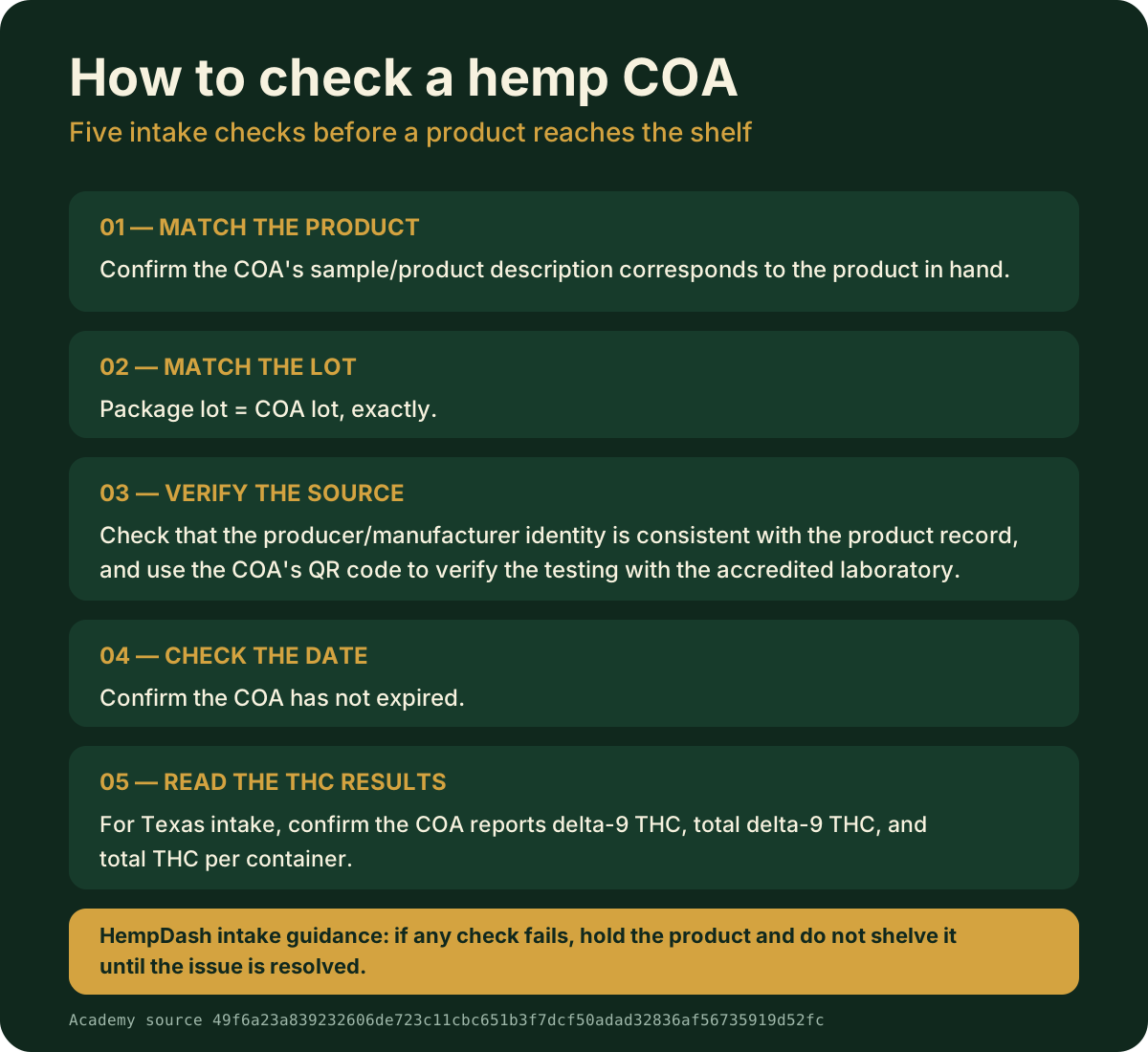
Pending HempDash compliance team primary-source verification — educational content, not legal advice.
Do
Do
Understanding COAs — Interactive COA Explorer
Explore a specimen COA
Below is a fictional specimen Certificate of Analysis, laid out the way real laboratory reports are. Select any numbered field on the document — or in the legend — to see what the rule requires, what to check at intake, and what a red flag looks like.
No field selected.
SAMPLE — EDUCATIONAL USE ONLY — NOT A LAB REPORT
Certificate of Analysis
Fictional specimen for education
Client / Manufacturer
Sample Information
Analytical Results
No signature — educational specimen; no real laboratory, license, or report number is represented.
Not a lab report
SAMPLE — EDUCATIONAL USE ONLY — NOT A LAB REPORT
This specimen is a fictional teaching document created by HempDash Academy. It is not a real Certificate of Analysis, does not describe a real product, and does not depict any real laboratory.
Select a numbered field on the specimen to see its explanation here: why it matters, where to find it, what the rule requires, and what to check at intake.
Ready to check a real COA?
See how HempDash helps you review COAs at intake and catch compliance issues before products reach your shelf.
Book a Demo →Prefer paper? Download the printable COA anatomy (PDF, free) — the specimen and field legend from the explorer above.
COA intake checklist
- Product name on COA matches the physical product
- Lot number on package matches lot number on COA
- Manufacturer name and address match
- QR code resolves to the same COA at the lab
- COA is unexpired
- Delta-9 THC, total delta-9 THC, and total THC are all reported; total delta-9 THC is within the 0.3% threshold
- Contaminant panels (residual solvents, heavy metals, pesticides, and harmful pathogens) are present and passing
- COA filed where you can retrieve it by lot number
Send this checklist to my inbox.
Test
Check your understanding
Apply
Apply
Next up: Total Delta-9 THC Math — pass this lesson’s quiz to mark it complete.
Apply this workflow in HempDashReview COAs with more confidence
HempDash reads the document and returns findings scoped to named, dated requirements, giving your team a structured way to review each COA during intake before a product is shelved.
Book a DemoStay current
Join the HempDash Academy email list for Academy updates. This is not an automatic regulatory-alert service.