August 20, 2026
The Twelve Fields a Texas COA Must Carry
A certificate of analysis with a THC number printed on it is not, by itself, a compliant COA. Under the adopted DSHS rules, 25 TAC §300.301(d) sets out the required contents of a certificate of analysis for consumable hemp products as a condition of sale in Texas, and the section names twelve fields.
This guide walks each of them, explains what the field is doing, and notes where a certificate most often falls short. It also marks, explicitly, the questions this record does not answer.
Source: 25 TAC §300.301(d), adopted rules filed with the Secretary of State March 2, 2026 (TRD-202601066). In effect March 31, 2026.
Why the field set matters more than the headline number
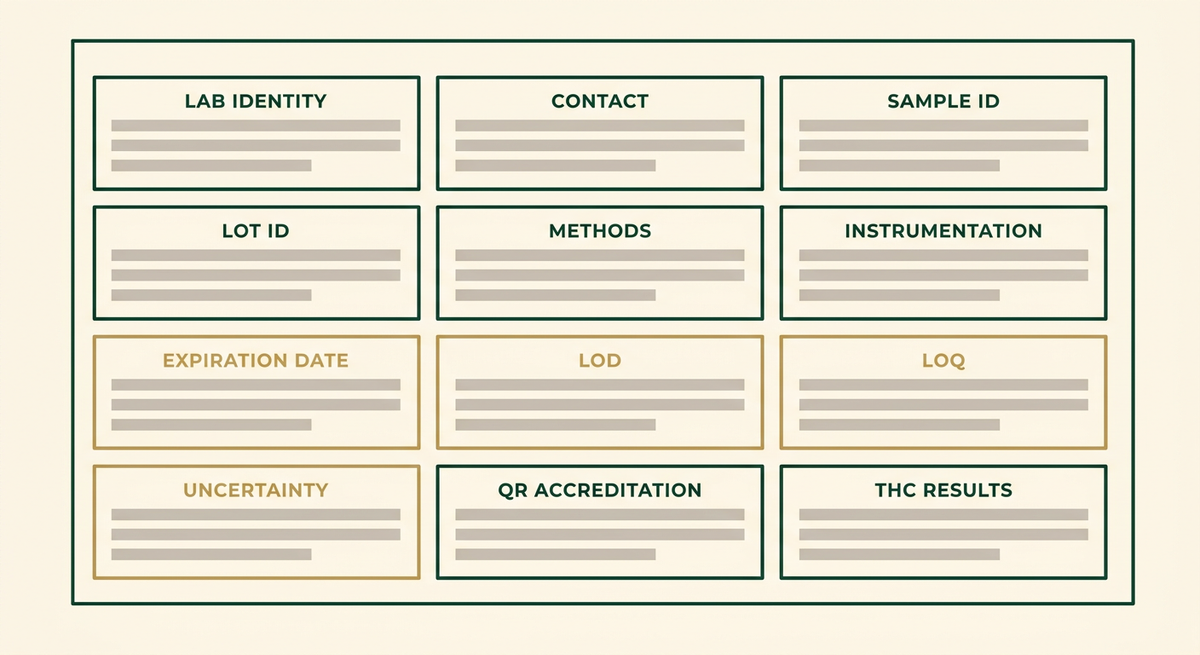
It is easy to evaluate a COA by looking for one thing: a THC figure that appears to be within range. That instinct is understandable and it is insufficient, because the rule does not describe a threshold test. It describes a document with required contents.
A certificate can be entirely genuine, issued by a properly accredited laboratory, describing a product that is in fact within limits, and still fail on required contents. The most common shortfalls are not fraud. They are omissions: a missing expiration date, absent limits of detection, no statement of measurement uncertainty.
Identity: who tested it, and what exactly was tested
Laboratory identification and contact information
The certificate must identify the laboratory and provide contact information. This is the field that makes the rest of the document checkable by someone other than you. A result with no attributable source is an assertion.
Sample and lot identification
The certificate must identify the sample and the lot. This is the single most operationally important field on the document, because it is the field that connects the paper to a physical thing.
A COA that does not identify a lot describes an abstraction. It may tell you that some material tested a particular way. It does not tell you that the jar on your shelf is that material — and the ability to make that connection is what an inspection actually tests.
Method: how the numbers were produced
Analytical methods and instrumentation
The certificate must state the analytical methods and the instrumentation used. Different methods produce different results on the same material, and the method is part of what the number means.
Limits of detection and limits of quantitation
The certificate must state limits of detection (LOD) and limits of quantitation (LOQ).
These two values determine what "not detected" is allowed to mean. A limit of detection is the smallest amount the instrument can distinguish from nothing. A limit of quantitation is the smallest amount it can measure with a reportable degree of confidence. Without them, "none detected" is uninterpretable — it might mean absent, or it might mean present below what this particular setup could see.
Measurement-of-uncertainty analysis parameters
The certificate must carry measurement-of-uncertainty analysis parameters.
Every measurement has a range. Requiring the range be stated, rather than implied by a single confident-looking figure, is what allows a reader to understand how close to a limit a result actually sits.
Time: the field that expires quietly
Expiration date
The certificate must carry an expiration date.
This is worth dwelling on, because it is the field that produces silent failure. A COA does not break. It expires. Nothing visible changes on the shelf, no system raises an alarm, and the document simply stops being current. A retailer relying on a certificate that passed its expiration date is relying on evidence that has lapsed without anyone doing anything wrong.
Authenticity: proving the lab was real
A QR code verifying authenticity of testing at an accredited laboratory
The certificate must carry a QR code verifying the authenticity of testing at an accredited laboratory.
The function of this field is to close the loop back to the issuing laboratory. A PDF is trivially editable. A verifiable route back to the accredited source is what distinguishes a certificate from a document that looks like one.
Results: three values, not one
Delta-9 THC, total delta-9 THC, and total THC per container
Section 300.301(d)(12) requires three separate results: delta-9 THC, total delta-9 THC, and total THC per container. A certificate missing any one of the three is non-passing on that field.
Total delta-9 THC deserves particular attention because it is a computed value rather than a directly reported one:
total delta-9 THC = delta-9 THC + (0.877 x THCA)
The coefficient reflects mass lost when THCA decarboxylates into delta-9 THC. The practical consequence is that a delta-9 figure which looks comfortable on its own can sit beside a THCA value that changes the picture materially.
There is a further corollary. Where a laboratory reports delta-9 without reporting THCA, the total is not simply missing from the page — it is underivable from the document in front of you.
Two clarifications that are frequently muddled
The twelve-field list is complete. There are no incorporated-by-reference additions elsewhere in the chapter that expand it.
The analyte list at §300.303(h) is separate. It is a distinct requirement and not part of the twelve. Treating the two as a single list produces a checklist that is wrong in both directions — it adds items the field-set rule does not require, and it obscures a requirement that stands on its own.
What this page does not tell you
Two questions are genuinely open, and this guide asserts neither.
The first is the enforcement posture attaching to the total delta-9 THC threshold. The threshold text is verified. How it is being enforced is a separate question and remains under review.
The second is anything about your specific product. Nothing here establishes that a given item may lawfully be offered for sale. A field-set review tells you whether a document carries what the rule requires of it. That is a narrower and more useful statement than a verdict.
A practical next step
Take one certificate off your shelf and check it against the twelve fields above — paying particular attention to the expiration date, the LOD and LOQ values, and the uncertainty parameters, which are the three most commonly absent.
You can also run a certificate through the free HempDash COA check, which reports findings per requirement. It does not render an overall verdict and it does not state that a product may be offered for sale; where a rule's enforcement posture is pending, it returns NEEDS_REVIEW rather than a pass. Documents are processed in memory only and are never written to a database, object storage, or temp file.
Want this handled for your store? See it working in one demo.
Book a Demo