August 20, 2026
Inspection Room: The Saturday Shift
Inspection Room is a recurring scenario series. The scenarios are constructed to be ordinary, because ordinary is where readiness fails.
The scenario
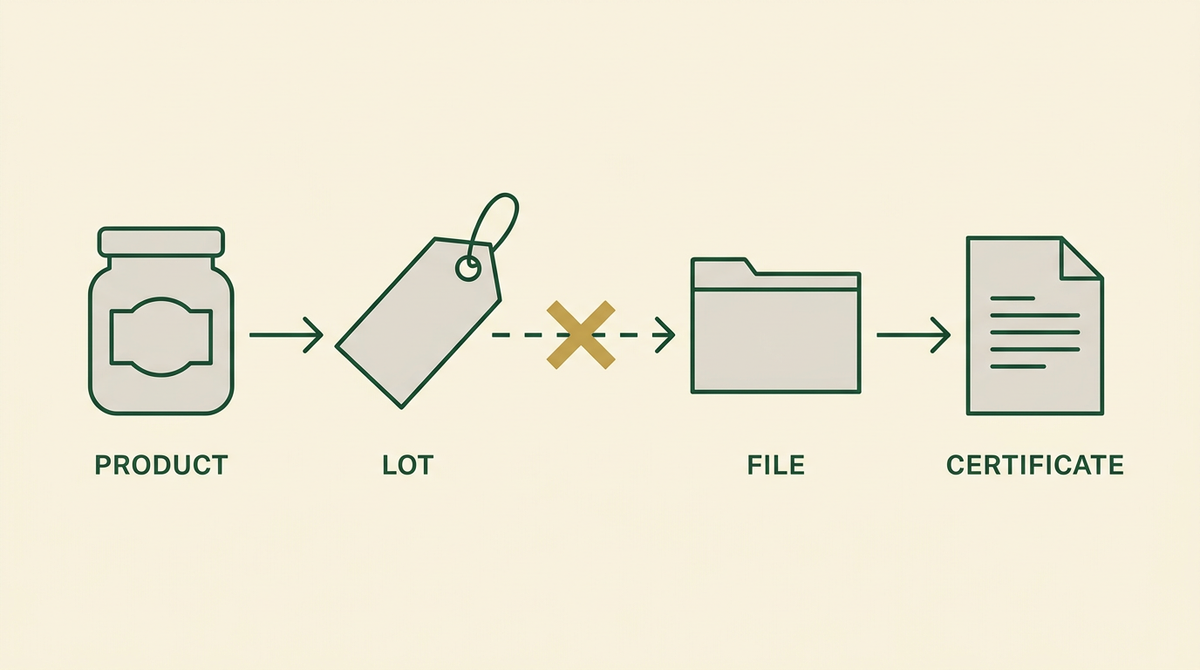
It is Saturday afternoon. The owner is not in the store. An inspector is, and they have pointed at a specific jar on a specific shelf and asked to see the certificate of analysis for that lot.
What has actually been asked
Notice what the question is not.
It is not "do you keep COAs." Nearly every operator keeps COAs. It is: show me the one for this, and the clock is however long somebody is willing to stand there.
That is a retrieval test, not a storage test, and the two require entirely different capabilities.
Where it goes wrong
The failure modes are mundane and they compound:
- The document is in an email thread. It exists, it is findable in principle, and nobody on shift knows which thread.
- Files are organised by vendor, not by lot. This makes sense when filing and is precisely wrong when retrieving, because the inspector is pointing at a lot.
- The person on shift has never opened the folder. They know the products, the register and the customers. The filing system was designed by and for someone who is not currently present.
- The lot on the jar does not match the lot on the certificate.
The expensive one
That last failure is categorically different from the others.
Product, lot or batch, and laboratory record all have to describe the same thing. Where they do not, the outcome is not a weak evidence position for that unit. It is the absence of usable evidence for it. You are not holding a certificate that is hard to find — you are holding a certificate that does not demonstrably describe the item in question.
This is the difference between having a COA and being able to prove the COA belongs to the product on the shelf, and it is the gap that most readiness work never addresses.
A test you can run this week
Pick three items off the shelf at random. Hand them to whoever is working. Ask them to produce the matching certificate for each.
Time it.
The result is your actual readiness, as distinct from your intended readiness. If the answer is "the owner would know," you have measured something real: the readiness of a person who is statistically unlikely to be present when it matters.
What to fix first
In order of value:
- Index by lot, not by vendor. Retrieval follows the question being asked.
- Verify that lot identifiers agree across the product, the receiving record and the certificate. Where they disagree, treat it as a visible open item rather than a close-enough match.
- Have one person who has never used the system find three documents. Their difficulty is the design brief.
- Check expiration dates. An expiration date is one of the twelve fields §300.301(d) requires, and a lapsed certificate fails silently — nothing on the shelf changes when the date passes.
What this scenario does not establish
Nothing here tells you whether a particular product may lawfully be offered for sale, and no readiness exercise produces a guarantee about the outcome of an inspection. What it produces is a shorter, better-evidenced answer to a question you will eventually be asked in person.
Want this handled for your store? See it working in one demo.
Book a Demo