August 20, 2026
Evidence Gap: You Have a COA. You Still Cannot Prove It Belongs to That Jar.
Evidence Gap is a recurring series with a fixed shape: you have X, and you still cannot prove Y.
This entry is the foundational one, because the gap it names sits underneath most of the others.
You have
A certificate of analysis. Genuine, from an accredited laboratory, carrying results that are within limits. Filed, backed up, and retrievable.
You still cannot prove
That this certificate describes the product in this jar, on this shelf, right now.
Why these are different problems
Holding a document is a storage problem. It is a solved problem, and it is the one nearly every compliance product solves: accept a file, keep it safe, retrieve it on request.
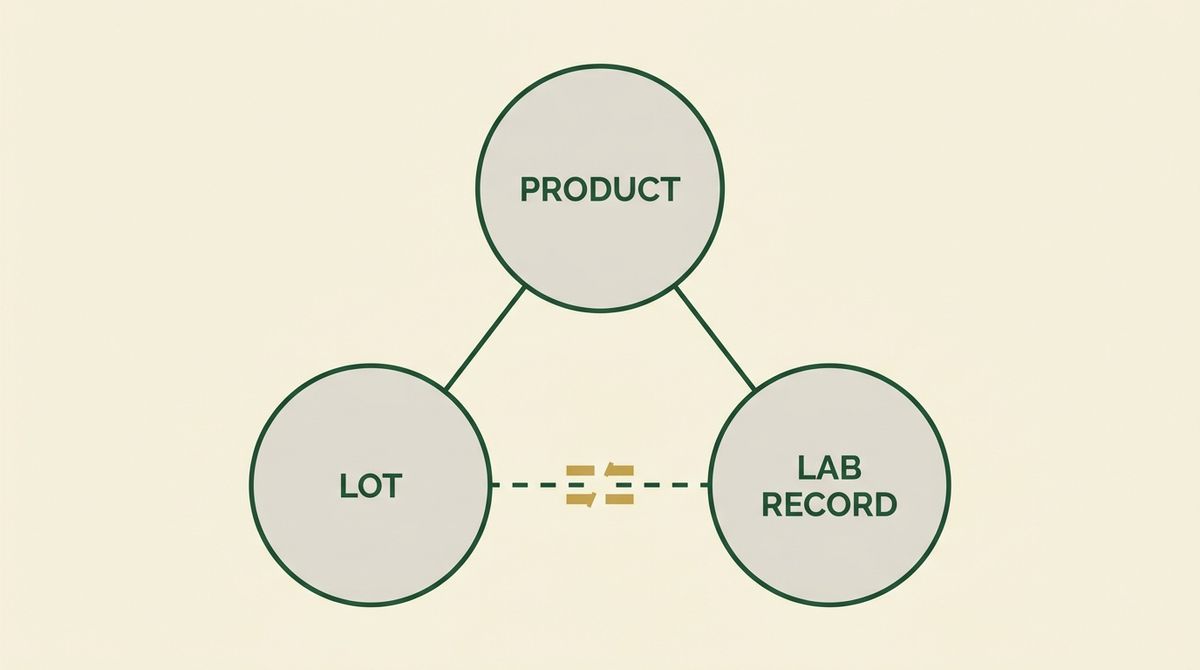
Proving that the document describes a specific physical item is a provenance problem. It requires that product, lot or batch, and laboratory record all describe the same thing — and that you can show why they do.
That is not storage. It is a join, and it has to survive somebody asking about it.
How the join breaks
Almost never through fraud. Through ordinary friction:
- the vendor recorded the lot number differently on the invoice than on the label
- the laboratory reported a sample identifier that maps to a batch rather than a lot
- a case was relabelled or repacked in the back
- two deliveries of the same product arrived close together and were shelved as one
Each of these is unremarkable on its own. Each of them severs the connection between the paper and the product.
Why this is the gap that matters
When the join is broken, you do not have a weak evidence position for that unit. You have no usable evidence for it.
The distinction is stark and it is easy to miss, because the certificate is still sitting there looking authoritative. Nothing about the document changed. What is missing is the ability to say that this document is about that item — and that connection is precisely what an inspector is asking for when they point at a jar.
Closing the gap
The instinct to reach for fuzzy matching is strong here, and it is exactly wrong. Same vendor, same week, probably the same lot: a probabilistic join produces a confident answer with nothing standing behind it. In an evidence system, that is worse than no answer, because the output is intended to be relied upon.
The honest approach makes mismatch a visible, first-class state — not an error to be swallowed, not a guess to be papered over, but a flag that says these two records disagree, here is exactly how, and a person decides what to do about it.
Slower and much less magical. It is also the only version that produces evidence you can actually stand behind.
Related
- §300.301(d) requires sample and lot identification among the twelve fields on a certificate — the field that makes this join possible at all.
- The Saturday Shift scenario in Inspection Room walks through how this gap surfaces during an actual inspection.
Want this handled for your store? See it working in one demo.
Book a Demo